A common question when organizing journey mapping sessions is whether providers and patients can be together in one session, because providers get so much value from connecting with patients and hearing their experiences.
That value is real, but it changes the purpose of journey mapping. The session is no longer about gathering candid feedback from patients to understand the journey. It becomes partly about the providers’ experience of hearing patients. In our observations, it can also add stress for patients.

Few studies have directly tested patient-only against mixed sessions for journey mapping. This section draws on the closest related research (focus groups, consensus meetings, and co-design) and on our own practice.
Honest Feedback
Power dynamics are real, and research on mixed patient-provider groups shows that status and role can shape who speaks and what gets said. In a UK study of mixed patient-staff groups discussing how to improve blood testing in primary care, a senior staff member dominated one of the two groups (Litchfield et al., 2018). In an Irish study comparing patient-only, mixed, and provider-only meetings, participants in the combined meeting described feeling undervalued and needing to feel safe, and the researchers concluded that involving the groups separately was more suitable (Racine et al., 2020).
In our experience, when patients, caregivers, and family share with providers present, they may hold back criticism or important details, whether consciously or unconsciously. This is more likely when their stories are sensitive, traumatic, or complex.
Patients also often tell us they worry that “negative” feedback could affect the care they receive in future. We hear this even when the project team has selected patients and providers who have no relationship. Related research supports the concern: patients’ willingness to speak up about concerns depends heavily on how staff behave and relate to them (Entwistle et al., 2010).
In patient-only sessions, we find patients speak more freely, and the feedback tends to be more detailed and focused on what matters most to them.

Emotional Labour
If providers are present, patients may take on additional emotional labour when sharing their stories. In our experience, this shows up in a few ways:
Self-Censorship to Protect Providers
Patients may soften or withhold criticism to avoid offending providers in the room. We’ve seen this add pressure and complexity compared to sessions where providers are not present.
Gratitude that Crowds Out Criticism
Many patients feel genuine gratitude for the care they’ve received, and some feel compelled to express it even when their own experience was inadequate or harmful. Research on patient feedback finds that gratitude and a wish not to appear ungrateful often lead patients to soften criticism or rate care positively even when it fell short (Staniszewska & Henderson, 2005). (Note that this research looks at surveys and individual evaluations, not group sessions.)
Reliving Trauma Without Adequate Support
Recounting traumatic or deeply personal experiences with providers present can be difficult. In our experience, without peer support, patients can feel emotionally drained afterward, especially if providers become defensive or dismissive.
Peer Support
Navigating your care journey can feel isolating. Patient-only sessions give people a chance to connect, listen, and validate each other’s experiences. In our observations, sharing with peers helps people feel less alone, and patients often exchange contact information to stay in touch after the session.
Centering the Patient Voice
Patients are the only people who experience the entire care journey, which makes them the authority on what that experience was like. For further reading, see Carman et al. (2013), which describes patient and family engagement as a continuum from consultation to partnership and shared leadership, across direct care, organizational design and governance, and policy making.
1:1 Interviews
Some patients may not feel comfortable sharing in a group, so we offer a 1:1 interview as an alternative. Studies comparing groups versus interviews for sensitive topics have found mixed results, so offering both lets people choose what feels safest for them. For example, in one randomized study, some sensitive topics came up only in focus groups, while in another, participants in individual interviews disclosed more personal thoughts and feelings about body image.
Indigenous-Led and Designed Sessions
When gathering feedback from Indigenous patients, it’s important this is done in relationship. This means the design of the session should be led by Indigenous facilitators, Elders, and community members, and respect cultural protocols. These processes take time, but it’s an essential part of decolonizing how sessions are facilitated, information is gathered, and supports Indigenous communities to lead.
This aligns with community-based research approaches, in which community members are involved in decisions from the beginning and the process responds to community and cultural values. See Community-Based Research (Arctic Institute of Community-Based Research).
Gathering and using this information must also follow the data governance principles of the community. For First Nations, this means OCAP® (ownership, control, access, and possession). OCAP® is a set of principles specific to First Nations. Inuit and Métis communities have their own frameworks for research and data governance, so ask the community or organization you’re working with what applies. How OCAP® is applied is for each First Nation to decide, and completing OCAP® training is not an endorsement of anyone’s work.

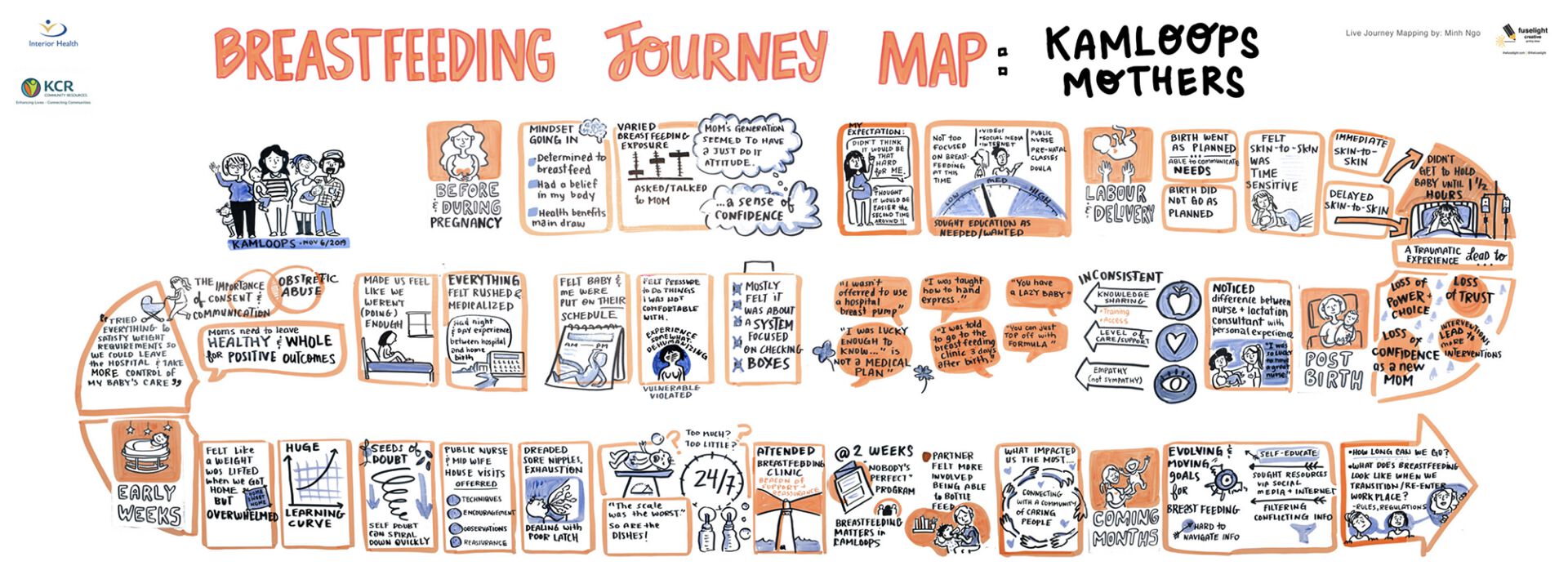
Indigenous co-facilitation at breastfeeding journey mapping project in Kamloops, BC
For non-Indigenous project teams, Decolonizing Project Management, and Working Effectively with Indigenous Peoples (a paid, 7-hour course) are possible starting points for working in relationship with Indigenous peoples and communities.
Graphic facilitation can also be a useful tool. Wright et al. (2023) describe using it in a community-led project with an Indigenous Friendship Centre to support OCAP® principles and reduce power imbalances.
Provider & Blended Sessions
Providers offer valuable perspectives on the care experience. Hosting a separate session for providers ensures that the patient voice remains central to the discussion. It’s best to hold the patient session first, so the maps can be reviewed during the provider session. This sequence, with separate patient and provider sessions followed by joint work, mirrors experience-based co-design (Donetto et al., 2015).

After gathering all this rich information on what is happening in the journey, many projects shift to Action Planning. While journey mapping is about identifying what happens in the journey, action planning sessions bring together patients, providers, and caregivers to connect, share stories, and prioritize areas for improvement.